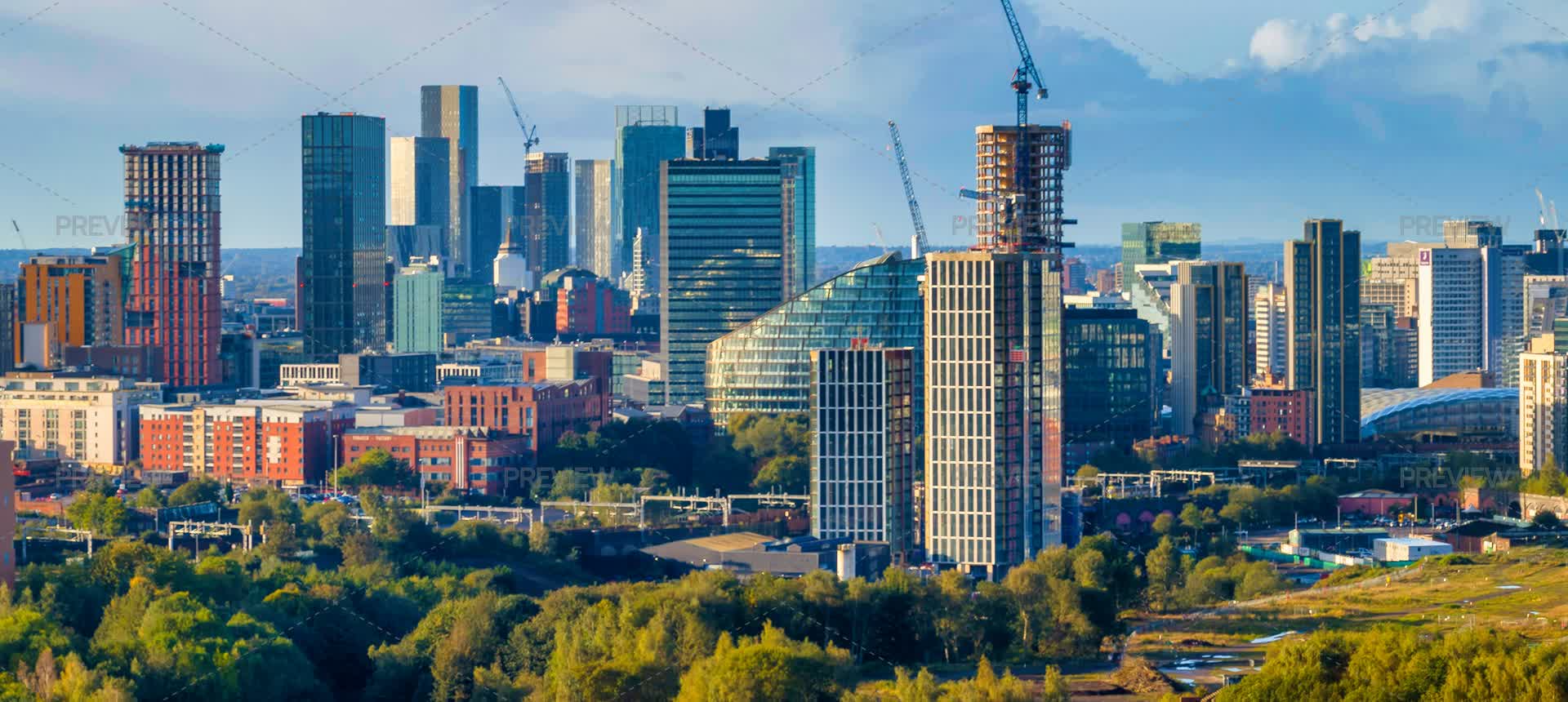
Manchester’s architectural landscape has massively evolved over the past few years, with a variety of ambitious skyscraper structures completely changing the city’s skyline. As more people than ever before look to live, work, and invest in the city, Manchester has seen continuous grand projects to help meet this demand, and it has now been revealed in new research from Barbour ABI that the increase in skyscrapers is set to make Manchester the fourth ‘tallest city’ in Europe.
The information comes from the ‘High Rise Construction Market Report 2026-30’ which has reviewed Manchester’s existing structures and those that are currently in the pipeline. The review reveals that Manchester is set to have 26 buildings over 100m tall, which would take it above cities such as Paris or Frankfurt.
London currently holds the third spot on this global list, as well as accounting for 57% of all tall buildings in the UK, but now Manchester is nipping at its heels. This growth in vast structures with ambitious designs in the city means great things for architecture jobs in Manchester and property jobs in Manchester, as well as assisting in putting the city on the global architecture map.
Manchester currently holds seventh place in the table, but with a surge of approved and planned schemes, this is set to change soon. The report reveals that if all of the schemes are delivered, the city will have more than 200 towers over 50m tall and 10 that are over 150m respectively.
The report calls out how Manchester is part of a ‘vertical boom in Britain’ in general, with an impressive 1,000 high-rise projects outside London in either a proposal or development state. This means that high-rise projects have quadrupled in five years, at a value of a staggering £51 billion.
Across Manchester, Liverpool, Salford, and Birmingham, there are 121 tower projects in the pipeline, and the remaining 85% of high-rise schemes are spread across cities such as Cardiff, Bristol, Leeds, and Glasgow, meaning that ‘while London still anchors the tall-building scene by height, it is no longer the whole story.’
Ed Griffiths, Head of Business and Client Analytics at Barbour ABI states ‘the pipeline shows regional city centres are scaling up fast. This is not a single-city phenomenon; it’s spread across 45 cities and large towns, and the majority of projects are already moving through planning. Residential work represents 86% of the total value of the towers proposed across the nation. This percentage drops to 74% when London projects are included in the analysis’ due to ‘a skew in London towards office or hotel-led projects.’
Manchester’s architectural identity has continued to evolve and now it is putting the city on the map as a real architectural leader. It will be interesting to see if all these projects come to fruition and if so, how this impacts its standing in relation to the capital city as well.